
How to Play
The rules of SCP: Dead Letter Protocol — how a run works, what each system does, and how to win.
The Objective
Each run is a single deployment to Site-19, and the facility is already coming apart. You investigate anomalies, contain the threats that break loose, and sharpen your operative — all while chasing the truth behind this run's K-Class Scenario: a civilization-ending event you were sent to stop. Solve it and you win. Let the site fall first, and it takes you with it.
- Complete three missions to unlock the final mission.
- Your decisions across the run determine which version of the final mission you face.
- Complete the final mission and stop the K-Class threat.
- Health reaches zero — your operative is killed.
- Stress reaches zero — your operative breaks.
- Entropy reaches 100% — the K-Class threat breaks loose at full strength.
- Three missions failed — you lose command, and the threat breaks loose at full strength.

Entropy
Entropy is the facility's instability, a single gauge that runs from 0 to 100%. It is the run's difficulty clock: the higher it climbs, the harder everything gets, and reaching 100% ends the run on your worst terms.

- A primary location breaches — its Integrity hits zero (+5%).
- Harmful events and the Entropy-phase crises that fire each cycle.
- A few Conditions, such as Ontological Fracture, which doubles what you gain.
- Shortcuts you take in a skill test that trade a slice of Entropy for extra dice.
- Gather Intel at the Command Center, which has a chance to cut it.
- Items and mission rewards that specifically reduce it.
- Favorable event outcomes and Conditions like Dimensional Anchor.
Entropy rarely falls on its own. Left alone it only climbs, so keeping it down is work you do across the whole run.
The higher Entropy sits, the more likely a new anomaly appears on the map each Anomaly phase — the facility spawns threats faster than you can clear them.
The Entropy phase that ends each cycle scales with the gauge, from minor setbacks early to facility-wide disasters as it fills.
Fill the gauge and the K-Class threat is unleashed at full strength, before you have prepared for it — a fight you are almost certain to lose. Entropy is not a background number; it is the clock you are racing the entire run.
Your Operative
You pick one operative before each run. What they excel at shapes your options: Knowledge favors containment, Strength favors destroying SCPs, Charisma favors talking your way through events. Two are free; the rest unlock with Clearance.

Analytical, with high Knowledge and Willpower. Suited to containment.
Free
Starts with an extra Action each turn.
Free
High Health. A durable field surgeon.
2,000 Clearance
High Charisma. Suited to talking her way through events.
3,500 ClearanceContainment Specialist
Analytical and unshakeable. His high Knowledge and Willpower make him the natural choice for taking SCPs alive.
- Unique Die
- Clinical Calm — a rolled 4 also grants +1 Stress relief
- Ability
- Compose — spend an Action to shed Stress
- Combat
- Assess — spend Command Points in a fight to gain Intel
- Starts With
- Gears' Logbook
Antimemetics Director
Fast and fragile. She starts each cycle with a fourth Action and a steady supply of Intel, trading resilience for tempo.
- Unique Die
- Total Recall — a rolled 5 also grants +2 Intel
- Ability
- Mnestic — spend an Action to gain Intel
- Combat
- Recall — spend Command Points in a fight to gain Intel
- Starts With
- Class-W Mnestics

Health
Your operative's life, spent in combat and events. At zero, the run ends.

Stress
Psychological reserve, spent by frightening events and attacks. At zero, your operative breaks and the run ends.

Strength
In combat, raises your attack damage. In tests, the stat for feats of force.

Defense
In combat, reduces the physical damage an SCP deals to you.

Willpower
Reduces damage to Stress, and is the stat rolled in tests of nerve.

Agility
Sets your movement points on the map and drives dodging, sneaking, and reflex tests.

Knowledge
The stat for every containment roll, and for research and technical tests.

Charisma
Powers the Talk action against SCPs and every social test with NPCs.

Actions
How many actions you take each cycle on the map. Usually three.

Alongside stats and current Conditions, each operative has four defining features:
Credits and Intel
Two resources carry across the run and pay for almost everything you improve: Credits, the facility's currency, and Intel, spent to study threats and bend the odds.

Earned from missions and by selling gear.
- Buy weapons and utilities at the Armory; equipment and utilities at Security.
- Build a containment cell at the Chambers (10,000, then 25,000 for the next).
- Unlock a locked item slot at Engineering (20,000 each).
- Augment an item at Engineering to improve it.
- Lock or unlock a die mid-test with Anchor or Annul (300 each).

Earned from rewards and operative abilities like Gears' Assess.
- Research an SCP in the Database to reveal its traits before you fight it.
- Reroll your first failed die in a skill test with Clarity (1 Intel).
- Stabilize an investigation to reset its Risk.
- Resolve certain events that call for hard intelligence.
Cycles and Phases
A run advances in cycles, shown as a Round counter. Each cycle runs four phases in a fixed order. You act during the Player phase; the other three resolve on their own.
Cycle repeats -- entropy escalates each round
Your active phase. You spend three Actions to move between locations, use shops and services, research SCPs, and investigate.
A narrative event occurs at your current location. Most events present choices, and many call for a skill test.
New anomalies appear and existing ones advance. An anomaly left unresolved becomes a live SCP.
A facility-wide crisis occurs. Its severity scales with the current Entropy level.
The Anomaly phase is where the facility turns against you, in a fixed order each cycle. Watching it play out tells you where threats are headed and which rooms are about to fall.
Every active anomaly ticks down toward becoming a live SCP.
Any that reach zero manifest as live SCPs on the map.
Fresh anomalies roll onto the map, with a higher chance the more Entropy has built up.
Anomalies drift toward their targets and SCPs move by their nature — hunting NPCs, seeking intact rooms, or wandering.
Each SCP standing in a primary location strips a point of that location's Integrity.
Lockdowns tick down, NPCs may be killed or arrive and leave, then the Entropy phase begins.
End your turn in a location that holds an SCP and the encounter begins then and there, instead of the phase advancing.

Missions and events can seal a location for a set number of cycles. Nothing enters or leaves while it holds — SCPs and anomalies are shut out, and so are you. It lifts on its own when the timer runs out.
Locations and Travel
Site-19 is a network of connected locations. The nine primary ones each have a special action and their own encounters — where you shop, research, recruit, and upgrade — plus Integrity that SCPs can breach to shut all of it down. Secondary locations have neither and rarely pay out.

 Rest
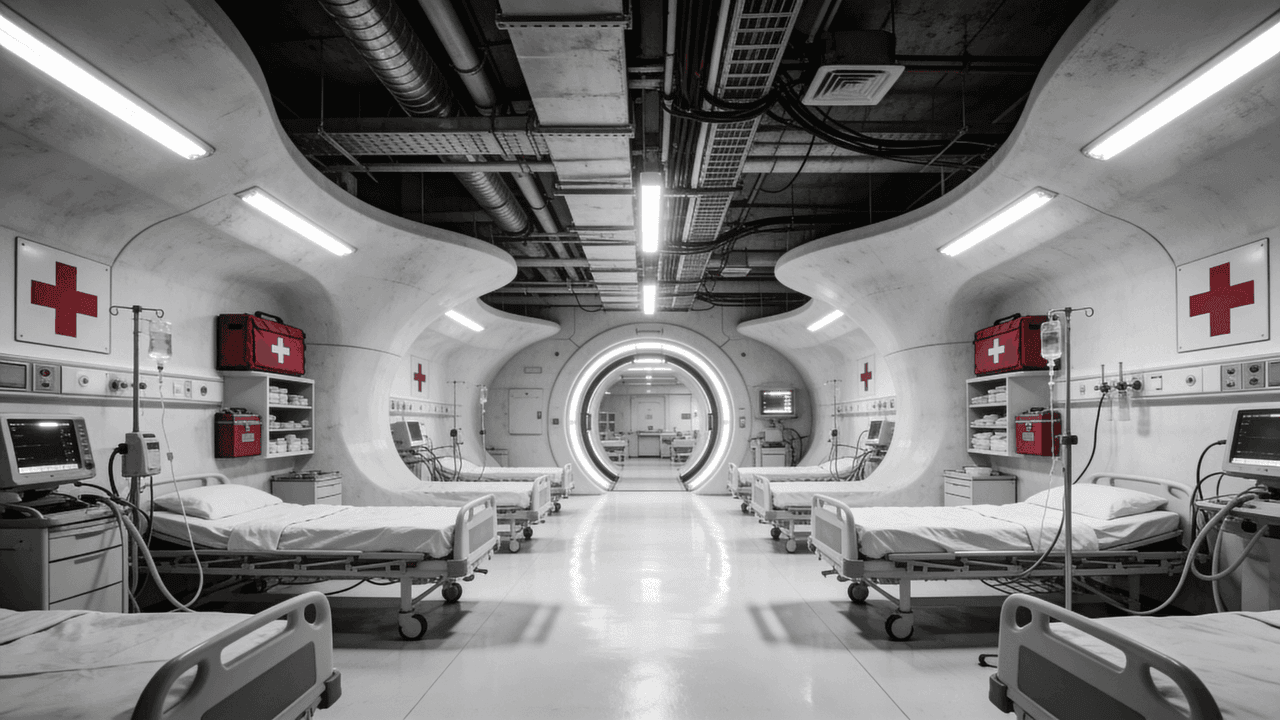
RestMedical Bay
Restore Health and Stress; heal your allies.
 Shop
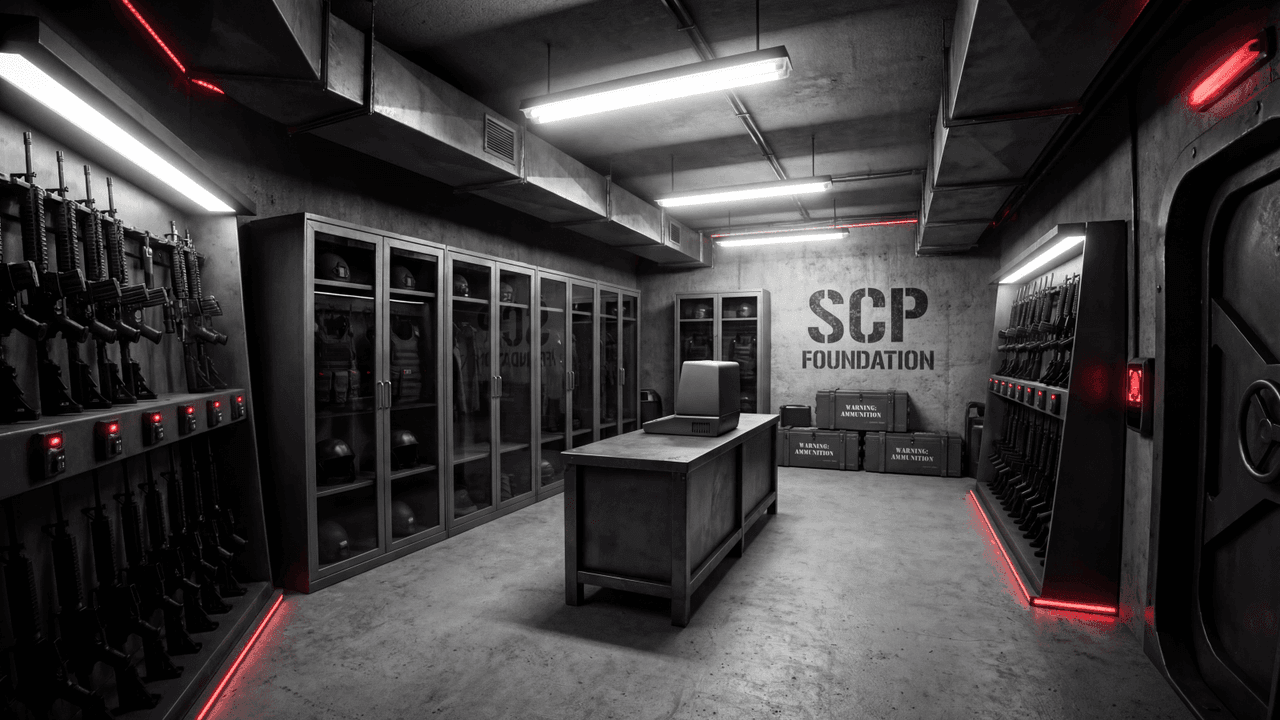
ShopArmory
Buy weapons and utility items.
 Shop
ShopSecurity Department
Buy equipment and utility items.
 Gather Intel
Command Center
Spend a turn to collect Intel from briefings.
 Research
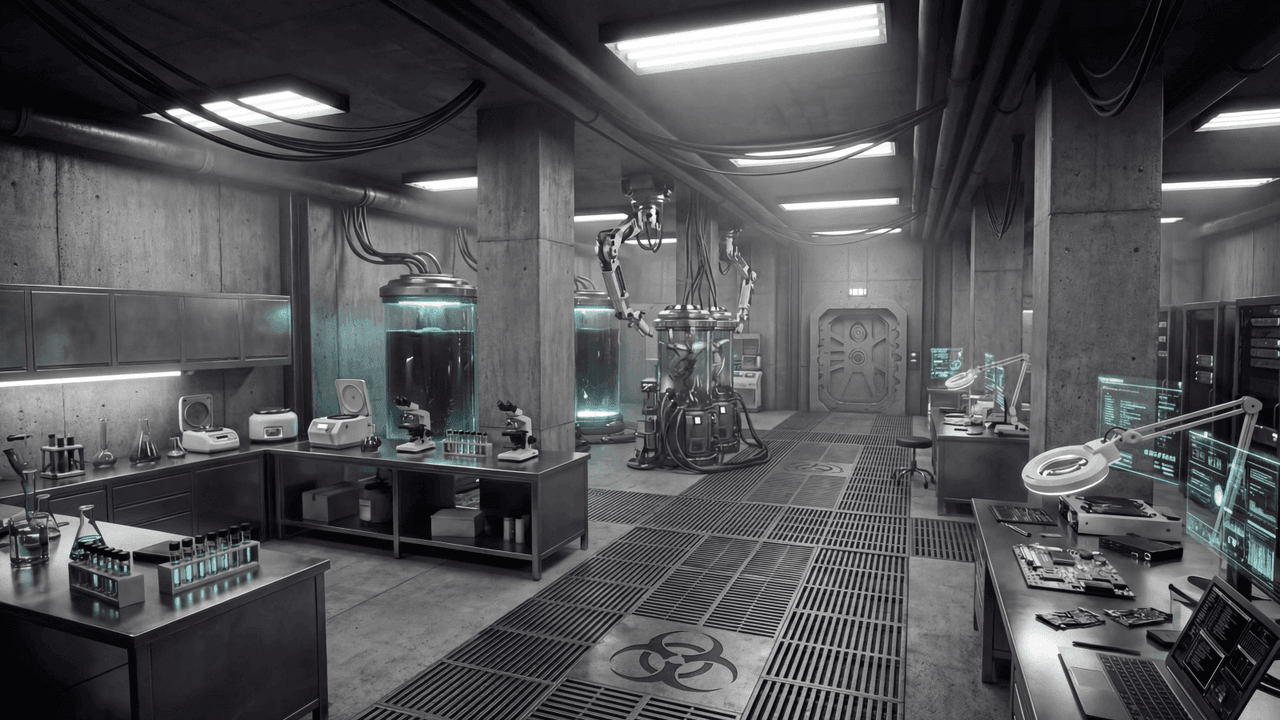
Research & Development
Study SCPs and earn research rewards.
 Upgrades
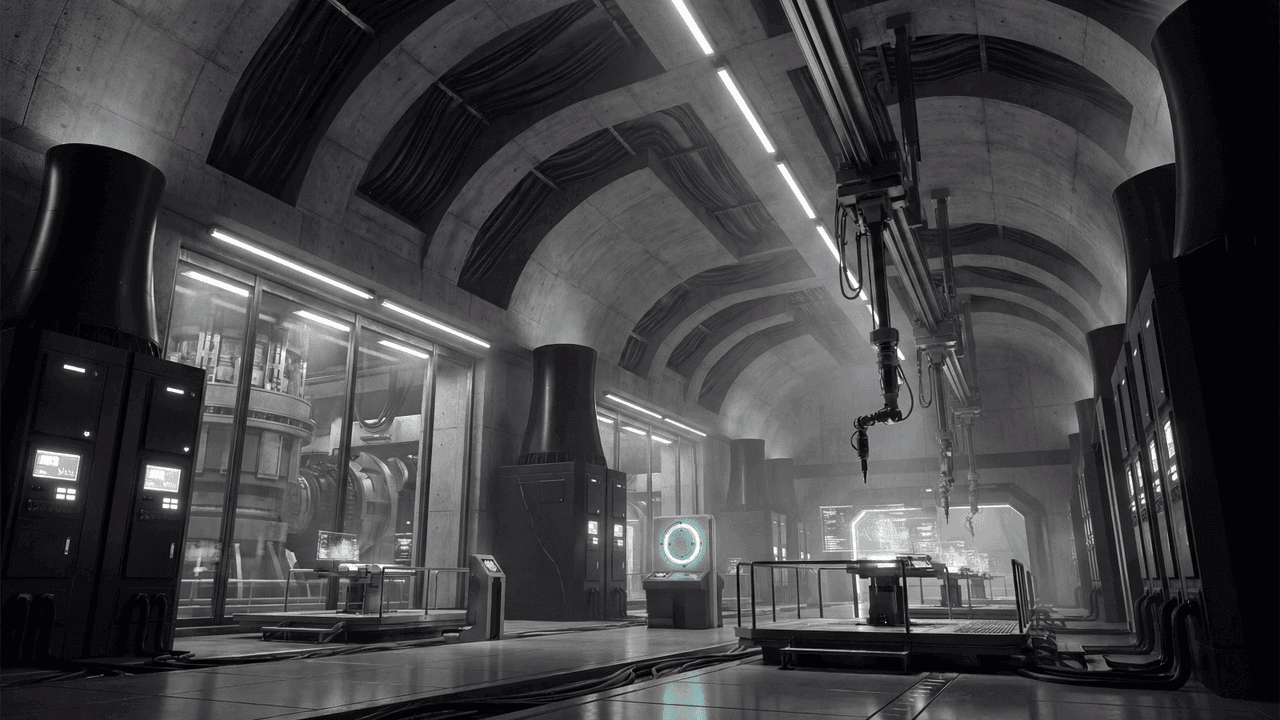
Engineering & Maintenance
Unlock a slot (20,000 cr) or augment an item.
 View Cells
Containment Chambers
Build cells; keep or destroy contained SCPs.
 Recruit
D-Class Dormitories
Recruit allies who meet your stat requirements.
 Travel
Exit
Deploy to external mission locations.
Integrity belongs to the primary locations — three points each, and only they have it. Every SCP standing in a location drains one point from it each Anomaly phase. Keep it above zero and the location keeps working.
At zero the location breaches: Entropy rises, its NPCs scatter, and its special action, encounters, shop, and Intel all shut off until you restore it. You raise Integrity back with item effects, and destroying an SCP in a location repairs one point on the spot.
Let the Containment Chambers breach and every SCP you have contained is released back into the facility at once. Defend them above all.


Move costs one Action and grants movement points to spend between connected locations. Higher Agility means more points per Move, so one order can cross several rooms. Cancel before confirming and the Action is refunded.
Some missions take place outside Site-19. Travel from the Exit to deploy, and Return when you are done. External locations run mission content only — no standard random events.
The narrative event you receive during the Encounter phase depends on your current location. If you need a particular reward, end your turn where it is most likely — the Medical Bay for Health, Research & Development for Credits.
Items and Gear
Everything your operative carries is a card. The front shows what it does — its type, cost, traits or effects, and its destroy and contain values. The back shows what it is. Click a card to flip it, just like in the game.
One real example of each item type. A red DESTROY value is its damage against a matching SCP; a CONTAIN value is how much it helps capture one alive.

Equipped to damage SCPs in a fight. Carries traits that must match the target.

Equipped for passive stat effects that last while it stays in a slot.

Used once for an immediate effect — restore Health or Stress, gain Actions.

A limited-use combat item, such as a grenade, with traits of its own.

A recruited character who fights, protects, and can be talked to.

Rare, high-power gear with strong destroy and contain values.

Held back for the final confrontation — never used on an ordinary turn.
Weapons, utilities, and technology carry traits (like alive or reality_bending) that must match an SCP's own traits to hit at full strength. Equipment and consumables carry effects instead — stat changes and healing. Allies come both ways, but no single item carries both at once.
You start with four usable slots: one locked to a Weapon, one to Equipment, and two that take any item. The other four are unlocked one at a time at Engineering & Maintenance for 20,000 Credits each. Your inventory holds far more than you can equip, so you re-equip to suit the SCP in front of you.
Most items are used in a fight: a weapon Attacks, a utility or consumable is spent with Use Item. A few instead do something on the map when you use them outside combat — SCP-1499's Gas Mask transports you elsewhere for loot, SCP-662's Silver Bell summons a butler. An item marked for the map cannot be used mid-fight, and vice versa.

Anomalies and the SCP Database
Anomalies appear on the map during the Anomaly phase and advance each cycle. An anomaly you leave unresolved becomes a live SCP and raises Entropy. Every SCP has four traits, which act as its weaknesses: your weapons and tools are fully effective only when their traits match.

Open the SCP Database to study a threat. Reveal spends one Intel to uncover two traits and its designation. Research spends another to uncover the remaining traits, its object class, and its full record. Combat stats become visible after the first reveal.
Spend Intel in the SCP Database before the encounter.
Use the Observe action during an encounter to reveal one trait.
Using an item that shares a trait reveals that trait.
An SCP you contained on a past run starts fully documented — destroying one does not.
Research an SCP and equip weapons that match its traits, or carry a range of weapons with different traits so that you have an answer for whatever appears.
The Database is also your threat board. It lists every SCP currently active on the map — where each one is and what it is doing — so you can plan a route around the rooms they hold and get ahead of the ones closing on you.
Matching an SCP's traits wins the fight, but many SCPs attack in narrative moments that turn on what they are. Knowing an entity's lore — how it kills, what it wants, what it fears — is often what lets you pick the right response and survive it.
SCP Encounters
An SCP encounter begins when you end your turn in a location with an SCP present, or choose Engage SCP. Each of your turns gives you four Command Points (CP) to spend on actions; then the SCP takes one.

Strike the SCP with your equipped weapon.
Reveal one of the SCP's hidden traits.
Change your equipped weapon or gear during the encounter.
Reduce the damage of the SCP's next attack.
Use a consumable or utility item. Allowed twice per turn.
Attempt to reason with the SCP. Some SCPs respond, raising the Vulnerability meter.
Command an equipped ally to attack the SCP or protect you this turn.
Use your operative's special ability.
Attempt to contain the SCP with a Knowledge dice roll. Available once its traits are revealed and the Vulnerability meter is full.
Attempt to flee the encounter.
End your turn and let the SCP act.
Each action can be used once per turn, except Use Item, which is allowed twice.
Two Outcomes
An SCP encounter has two winning outcomes: destroy the SCP, or contain it. (You can also flee — see below.)

Attack with a matching weapon until the SCP drops; each strike resolves on its own. Faster than containing, but pays less: Credits and one point of the location's Integrity restored.

Reveal the SCP's traits and fill its Vulnerability meter through Observe, Talk, and the right items, then attempt the containment roll (a dice test — see Skill Tests). Harder, and worth more: Clearance, plus a contained SCP you can keep for a passive bonus or cash in later.
Matching Traits
Your attack damage depends on your Strength, the weapon's destroy value, and — above all — whether the weapon's traits match the SCP. A matching weapon does maximum damage; a mismatch does very little. So reveal an SCP's traits and equip to match, or Observe and Re-equip once you see what you face.
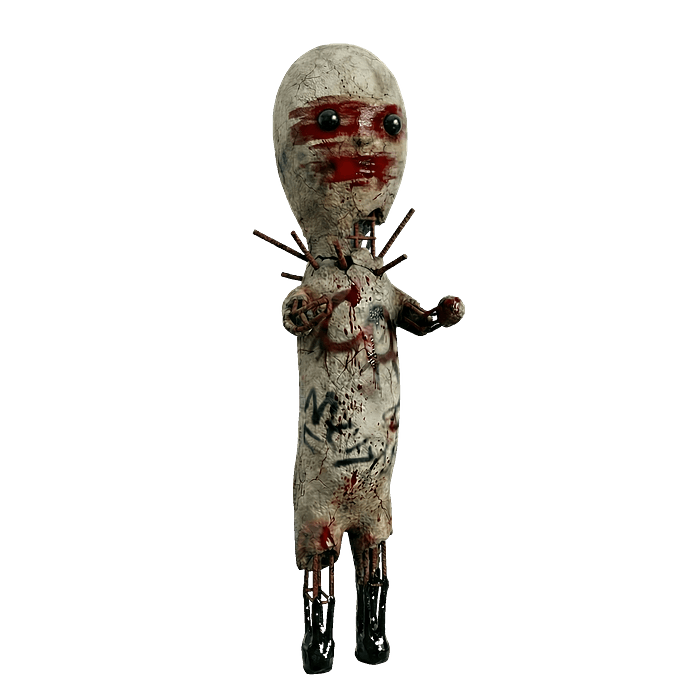
The SCP's Action
The SCP takes one action per turn. Its chance to hit is its speed and perception against your Agility, so Agility both moves your operative and helps it evade. Damage that lands is reduced by your Defense against physical attacks, or your Willpower against attacks on the mind.
Some SCPs target Health and others target Stress. If either reaches zero, the run ends.
Some SCPs are passive and will not move against you until you strike. Your first Attack turns a passive SCP hostile for the rest of the encounter, and it stops responding to Talk. Sometimes the safest play is to research, contain, or simply leave — not to swing.
Run costs four Command Points and is not guaranteed. Before an encounter even begins, you can attempt to Sneak past an SCP and skip the fight entirely. You are not required to fight everything; leave a threat and come back once you are equipped for it.
Destroying is usually the easier, faster answer, and it pays Credits. Containing is harder and needs an open cell, but it awards more Clearance and gives you a held SCP that strengthens your future encounters.
The Containment Chambers
Contained SCPs are held in cells at the Containment Chambers, where you decide what to do with each one.
You start with a limited number of cells. Build more for 10,000 then 25,000 Credits, so you can hold several SCPs at once.
A held SCP is passive gear. Any item you equip that shares one of its traits counts at full strength, so a well-chosen collection makes every fight easier.
Terminate a contained SCP for an immediate Credit payout and a free cell. You trade its passive benefit for cash when you need it.
Skill Tests and Dice
Dice come out for the containment roll and for skill tests during narrative events. You roll a pool of them and pass by hitting enough successes; the size of the pool and the odds on each die are yours to influence.
The size of your dice pool is set by the stat the test checks, adjusted by your equipment, your Conditions, and the test's difficulty. Each die that lands on a 5 or 6 is a success. The panel shows how many successes you need and how many dice you have. Press Test Fate to roll, spend your mitigations, then Accept Fate to commit. Passing is a Good Fate; falling short is a Bad Fate.
 Locked failure — this die is stuck and cannot be re-rolled.
 Success.
 Success, and this die locks so a re-roll can't lose it.
Faces 2–4 have no effect. Harder tests may only count 6s.

A roll is not final. Before and after the dice land you can spend resources to improve the result. Each option is used once per test, and each has a price.
Your dice are not fixed. Each operative's Unique Die rewrites one face — Gears turns a 4 into recovered Stress. Conditions rewrite faces too, for better or worse. Some items and abilities grant extra dice or re-rolls. Two operatives rolling the same pool can get different odds.
A narrative test uses whichever stat the event calls for, and failing plays out in the story. The containment roll always uses Knowledge, its difficulty is the SCP's containment rating, and failing lets the SCP strike back with a Purge — though your progress carries into the next attempt.
Conditions
Injuries, anomalous effects, medicine, and facility crises all leave your operative with Conditions. Each one changes your stats, your dice, or what happens to you every cycle, and they stack until something clears them.
Physical harm. Usually drains Health each cycle or lowers a physical stat.
−1 Health each cycle
−2 Knowledge for 5 cycles
−2 Health each cycle until treated
Mental or anomalous harm. Warps your stats, your dice, or the facility around you.
A rolled 5 becomes a locked failure
−3 Charisma; the interface starts lying to you
Entropy rises twice as fast
An anomalous benefit — power taken from the things you contain.
+1 re-roll; better evasion in combat
+3 Knowledge
A rolled 2 becomes a locked success
Foundation treatment — temporary buffs from medicine, stims, and field kit.
+2 Strength and extra Command Points for 4 cycles
+3 Willpower for 5 cycles
Raises your maximums and heals each cycle for 3 cycles
Facility-wide states forced by a crisis. They hit everyone until they expire.
−1 Defense, Agility, and Willpower for 3 cycles
−2 Knowledge; your Stress is hidden for 4 cycles
−1 Agility and Defense, but Medical care is free
A few conditions change what a die face means. Cognitohazard turns a rolled 5 into a locked failure; Eldritch Insight turns a rolled 2 into a locked success. A condition can help or hurt the same roll — read them before a hard test.
Negative conditions do not fade on their own unless they list a duration. Remove them with the Augment action at Engineering & Maintenance, which improves a consumable and strips your negative conditions at the same time, or with items and events that cure specific conditions. Rest at the Medical Bay restores Health and Stress, not conditions.
Investigations
Some missions and locations open an investigation. You move through the scene and interact with points marked by icons to find what you need. Each meaningful interaction raises the Risk meter.

Inspect an object. This is how you find what an investigation requires.

Move to another part of the scene. Free to use again once opened.

A blockage. Clearing it reveals new points to interact with.

Read background detail. This carries no risk.
- 01Read the Observe points first — they cost nothing and set up the scene.
- 02Examine points to find what the objective needs; each interaction adds to Risk.
- 03Clear an Obstruction to reveal hidden points, and use Passages to move around.
- 04When Risk climbs, spend one Intel to Stabilize and reset it.
- 05Once you have found what is required, leave — pushing for extras invites a complication.
As the Risk meter rises, so does the chance your next interaction triggers a complication. A complication ends your turn, and the facility's other phases resolve while you are away. Enough of them end the investigation in failure — spend one Intel to Stabilize and reset Risk before it gets there.
Missions and the Final Mission
Missions are your assignments from Deployment Orders. Complete a mission's objectives — travel somewhere, resolve an SCP, recover an item, hold a position — to finish it.

Must all be completed to finish the mission. Some appear only after you trigger them, and some carry a cycle limit — miss the deadline and the objective fails, with a cost to Health, Stress, or Entropy.
Bonus goals. You can finish the mission without them, but completing them pays extra.
Extra assignments offered by NPCs and events, layered on top of your current mission for their own rewards.
Crisis tasks that surface as Entropy climbs — usually to pull a location or the facility back from the edge.
Each scenario has far more missions than a single run will ever show you. When three appear, they offer the same possible rewards — none is strictly better. What differs is their objectives, their lore, and the decisions they put in front of you, which is what shapes your ending.
Major decisions across the run are tracked across three philosophical approaches. Whichever you favor most determines which version of the final mission you face.
Lock the threat away.
Study it and find a cure.
Destroy it.
Complete the final mission to stop the K-Class threat and win. Fail three missions along the way and it breaks loose at full strength instead.

Improving Your Operative
Your operative grows over a run in three ways: permanent stat gains, more equipment slots, and the gear you equip.
Some location events permanently raise a stat by one — for example, maximum Health at the Medical Bay, or maximum Actions at Research & Development. They are usually earned by passing a test or making the right choice, and announced as a permanent improvement.
At Engineering & Maintenance, the Upgrades service unlocks one of your locked equipment slots for 20,000 Credits. Certain reward events unlock a slot as well. More slots mean more gear equipped at once.
An equipped item's bonuses apply only while it stays in a slot. Unequip it and they are gone — unlike stat gains, these never stick.
An operative's Unique Die and Ability are fixed for the run. Only stats and equipment slots improve while you play; everything else carries over between runs as Clearance unlocks.
The K-Class Threat
The run ends in a confrontation with the K-Class threat. It plays as a special encounter: you can only Attack, Defend, and Use Item — there is no Observe, Talk, or Run. Instead of the Vulnerability meter you fill a Threat Analysis meter, and winning means neutralizing the threat before it ends you.
Contingency items are collected across the run and saved for this fight. There are three kinds, each used at a different moment.
Played during Finding Moments to raise Threat Analysis. The correct report adds the most; a wrong one costs you Health or Stress.
A combat item used on your own turn for a direct effect.
Spent during the Neutralize roll: Exploit lowers the successes you need, Adapt turns a low roll into a success.
During the threat's Finding Moments, play the correct Field Report to raise Threat Analysis. Once it reaches 100%, the Neutralize action opens a final dice roll — pass it and the scenario is averted. Fail the run, and it is over.
Complete the final mission and you face the threat weakened: Threat Analysis starts partly filled and the Neutralize roll needs fewer successes. Arrive by failing three missions or letting Entropy reach 100%, and you face it at full power, from nothing.
Clearance and Unlocks
Every run awards Clearance, whether you win or lose. You earn it for SCPs contained or destroyed, missions completed, and the run's outcome, with a win awarding the most.
Clearance is permanent and carries across runs. Spend it to unlock additional operatives and scenarios. Any SCP you contain stays fully documented in the SCP Database on future runs, so a threat you have captured before is one you can prepare for the next time it appears.
By object class: Safe 150, Euclid 175, Keter 200
By object class: Safe 75, Euclid 90, Keter 100
Bonus the first time you resolve a given SCP
+50 for all objectives, +100 the first time
Durable field surgeon
High Charisma and Defense
The Flesh That Hates
More operatives and scenarios are planned as the game grows.
Entropy only climbs on its own. Defend your locations from breaches and spend Gather Intel at the Command Center to push it back down.
You have three Actions per turn. Prioritize the one or two that matter most.
Spend Intel in the SCP Database to learn an SCP's traits, then equip weapons that match.
Destroying an SCP is quick, but containing one awards Clearance and lasting benefits.
Either reaching zero ends the run. Restore both before high-Entropy crises.
Use Sneak or avoidance against SCPs you are not equipped to fight.